Pengelly Garden Centre
Apple (Malus) Bramley's Seedling — Patio, 11.5L container, M27
Apple (Malus) Bramley's Seedling — Patio, 11.5L container, M27
Couldn't load pickup availability
Bramley's Seedling is Britain's best-loved cooking apple, and this patio-sized tree means you can grow your own even on a terrace or in a courtyard. Its story began in 1809 in Southwell, Nottinghamshire, when a young Mary Ann Brailsford planted a handful of apple pips in her family's garden. The cottage was later bought by a local butcher, Matthew Bramley. When a young nurseryman, Henry Merryweather, asked to propagate the tree in the 1850s, Bramley agreed on the condition that the apple carry his name. More than two centuries on, it holds the RHS Award of Garden Merit.
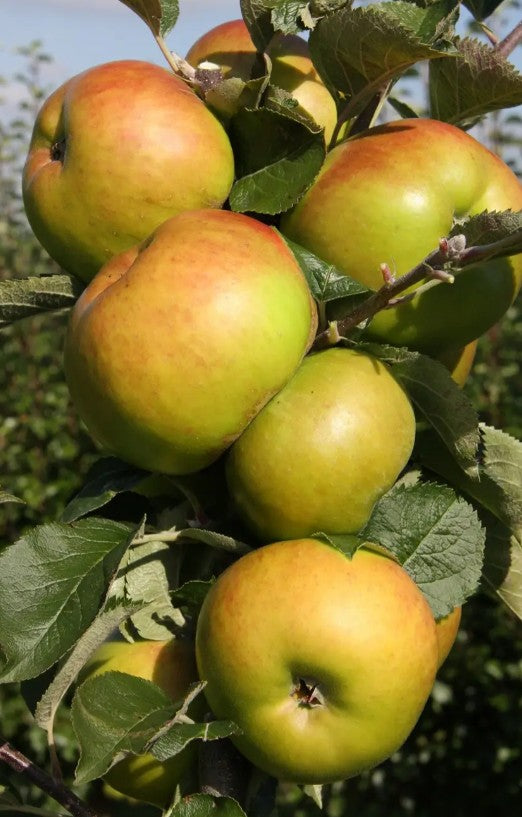
The large, flattish green apples are often flushed with red on the sunny side. Their sharp flesh cooks down to the light, golden, fluffy purée that traditional English recipes call for, making them the classic choice for crumbles, pies, sauces and chutneys. Pick the fruit in October, and stored somewhere cool it will keep until March.
This tree is grafted onto the very dwarfing M27 rootstock, which tames Bramley's naturally vigorous habit. It reaches around 1.8–2m tall, making it well suited to a large patio container, a small border or a courtyard. Grow it in full sun or light shade in a well-drained, loam-based compost. As the tree establishes, move it into a generous pot at least 50cm across. M27 trees have a small root system, so keep the tree permanently staked and water it regularly through the growing season, especially while the fruit is swelling. A spring feed with a balanced fertiliser keeps cropping steady. Trees on M27 usually begin fruiting within a couple of years of planting.
Bramley is a partial tip-bearer, carrying some fruit at the ends of the previous year's shoots. When pruning, leave some of the shorter shoots unshortened so you don't remove next year's crop. It is also a triploid, which means it cannot pollinate itself or other apples. For a good crop it needs two other compatible apple trees nearby that can also pollinate each other, such as Discovery and James Grieve. In most built-up areas, neighbouring gardens often provide this.
Each tree is hand-selected before dispatch.
Available from Pengelly Garden Centre.
Share